
When planning a new home or development project in Southern Oregon, most property owners focus on the architecture of the house or the layout of the landscape. However, in our experience, one of the most critical regulatory hurdles involves what lies beneath your tires before you even reach the front door. Adhering to Jackson County’s Driveway Design Standards is not just a matter of convenience; it is a mandatory requirement for obtaining building permits and ensuring emergency services can protect your investment.
What are Jackson County’s Driveway Design Standards?
Jackson County’s Driveway Design Standards are mandatory design requirements within the Land Development Ordinance (LDO) that ensure safe access for residents and emergency vehicles. These standards regulate the distance from the driveway to the structure (within 150-feet), require an all-weather surface capable of supporting 50,000 pounds, maintain a 13.5-foot vertical clearance, and limit steep grades to ensure fire trucks can navigate the property safely.
The Critical Role of Fire Safety in Access Design
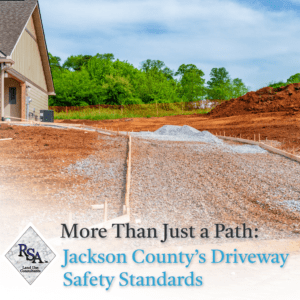
In Southern Oregon, the threat of wildfire makes access standards a high priority for local planners and fire marshals alike. We have found that many landowners view a driveway as a personal preference, but the Jackson County Land Development Ordinance (the Ordinance) treats it as a piece of essential infrastructure. Every new and existing structure located on a lawfully established unit of land must meet these minimum access design standards prior to the issuance of building permits.
The core philosophy behind Jackson County’s Driveway Design Standards is “practical and physical access”. This means your driveway must be more than just a cleared path; it must be a reliable, all-weather route that can accommodate a heavy fire engine during the worst possible conditions.
The ‘150-Foot’ Rule: Proximity and Protection
One of the most frequently misunderstood aspects of the Ordinance is the requirement for structure proximity. Under the standards, driveway access must extend to within 150 feet of any portion of the exterior walls of the first story. This distance is measured by an approved route around the exterior of the structure.
If your building site is on a large rural lot, this rule dictates exactly how far your driveway must go. Our team recommends addressing this early in the feasibility stage, as it directly impacts your excavation/grading costs.
Weight, Width, and Clearance Requirements
A standard passenger vehicle weighs about 4,000 pounds, but a fully loaded fire tanker is a different story. Jackson County’s Driveway Design Standards require that all access ways be designed and constructed to carry a vehicle weighing at least 50,000 pounds. For certain areas, the driveway must even have the ability to support an occasional fire vehicle weighing up to 60,000 pounds.
To support this weight, the Ordinance specifies construction with a minimum of six inches of “4-inch minus” base rock or an equivalent all-weather surface. Beyond the ground’s strength, you must also consider the space above and beside the path:
- Width: The minimum total surface width, including shoulders, must be no less than 12 feet. If your driveway has sharp curves with a centerline radius of less than 55 feet, that width must increase to 14 feet.
- Clearance: A minimum clear height of 13.5 feet must be maintained for the entire width of the driveway. This often requires pruning or removing “historic” or mature trees that would otherwise block the passage of emergency equipment.
Navigating Steep Grades and Curves
Southern Oregon’s beautiful hillsides present unique challenges for Jackson County’s Driveway Design Standards. Fire trucks struggle with steep inclines, which is why the Ordinance is very specific about the “grade” or slope of your driveway. The approach from a public or private road cannot exceed a 10% grade for the first 40 feet.
Once you are past the approach, the general maximum finished grade is 15%. In our experience, if you must exceed this, you are required to consult with the local fire district or the County fire safety inspector. They may allow a grade of up to 18% for short intervals of 100 feet, provided there are no more than three such sections per 1,000 feet of driveway. Furthermore, if your grade exceeds 15%, the minimum centerline curve radius must be increased from the standard 48 feet to a much wider 100 feet to ensure trucks don’t lose traction or tip.
Turnarounds and Turnouts: Essential Maneuvering Space
Safety is not just about getting to the house; it is about being able to leave or turn around. Dead-end access ways must incorporate an approved turnaround arrangement—such as a cul-de-sac or hammerhead—within 150 feet of the structure.
On single-lane access ways, turnouts are required at a maximum of every 800 feet. These turnouts must be at least 50 feet long and 7 feet wide, with 25-foot tapers on each end, allowing passenger and emergency vehicles to pass one another during a crisis.
Bridges, Culverts, and Addressing
If your property requires crossing a stream or irrigation ditch, the bridge or culvert becomes part of the driveway safety check. New bridges must have a driving surface of at least 12 feet wide and be certified by a professional engineer to support 50,000 pounds.
Finally, emergency crews cannot help if they cannot find you. Visible address signs, acceptable to the fire district, must be posted at the entrance to the public right-of-way. If your access way forks to serve multiple homes, the addresses for each fork must be clearly listed at the intersection.
How RSA Oregon Can Help
Navigating Jackson County’s Driveway Design Standards can be a complex process that involves engineering reports, fire safety inspections, and precise mapping. We perform extensive research on existing conditions and areas of special concern to determine what specific standards your property must meet.
Our team begins every project with a feasibility and project analysis to ensure your plans for a driveway or access road will meet the Ordinance before you invest in expensive excavation or paving. Whether you are dealing with steep slopes, expansive soils, or complex turn-around requirements, we have the experience to help you reach your goals.
Do I need a permit for my existing driveway in Jackson County?
Maybe. In Jackson County, the planning department may require permits for grading an existing driveway, as well as for widening a driveway or adding a second access point for a circular drive.
What is the weight limit for a residential bridge in Jackson County?
New bridges and culverts must be designed and maintained to carry a fire vehicle weighing at least 50,000 pounds. A bridge carrying capacity report, prepared by a professional engineer, is required for all new bridges.
What is an “all-weather surface” for a driveway?
According to the Ordinance, an all-weather surface typically consists of a minimum of six inches of 4-inch minus base rock or an equivalent material and 3/4 inch-minus rock that remains stable and passable during Southern Oregon’s wet winter months.